The library that made Jonty Claypole
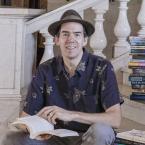
Jonty Claypole MBE – writer, podcaster and documentary producer – talks about the library that made him.
State Library of New South Wales
LTMM_Podcast_Jonty_Claypole.mp3
Welcome to the Library That Made Me Podcast.
I’m Phillipa McGuinness from the State Library of NSW.
On this podcast, we ask some of Australia’s most loved writers, historians, thinkers and performers to reflect on the libraries that have shaped them.
Today you’ll hear from Jonty Claypole. Jonty Claypole is CEO of Red Room Poetry and co-host with Sophie Gee of the popular podcast Secret Life of Books.
Jonty Claypole
Despite what you might imagine, libraries and obsessive-compulsive disorder don’t go well together. Sure, there’s the cataloguing, the quietness, the shushing and firm finger-wagging, but the presence of other people remains a problem. Far from being quiet, they fidget, pick their noses, scratch their balls, giggle with their friends and flirt. While I have loved some libraries, I harbour unChristian feelings about the people I share them with.
Then there’s the books themselves. Stained, dog-eared, dirty and well thumbed. Some even have laminated covers, smudged with oily fingerprints like the windows of suburban trains. Libraries, like public transport, require frequent handwashing. The obsessive-compulsive’s favourite library is their private one. There alone, books can be controlled like citizens of a totalitarian state, through advanced strategies of population control. They can be regimented alphabetically, by genre, or according to colour (although police checks should be mandatory for those who practise the latter).
My library was formally established in 1995, when I unpacked two cardboard boxes in my narrow room on the ground floor of Peckwater Quad in Christ Church college at the University of Oxford. Less than 50 books in total. Half pilfered from my parents, without their permission, and therefore of dubious provenance. The other half legitimately purchased as part of the reading requirements before term began.
A new friend lent me his copy of Ian McEwan’s Black Dogs. His name was rubber-stamped inside the cover, with the legend ‘ex libris’ (Latin for ‘from the library of ‘) above, suggesting a vast room in the English countryside with south-facing windows, ornate shelves carved by Grinling Gibbons (the Michelangelo of woodwork), and books bound in the skin of unborn animals. Rather more modest than Virginia Woolf, I dreamed only of a rubber stamp of my own, through which to engineer the apotheosis of my paltry collection of paperbacks into a heavenly libris.
Oxford was full of bookstores. Brash, modern chains, like Waterstones, as well as down-at-heel second-hand stores like Mr Charrington’s shop in Nineteen Eighty-Four. The proprietors were dishevelled men in cardigans with an air of failed academia, multiple cat ownership and pornography.
I dislike second-hand books for the same reason I dislike library books, but life on a student grant has its own compulsions. I acquired outdated editions of the classics. Dostoevsky and Tolstoy translated into Edwardian English (“It’s jolly cold, today,” said Raskolnikov). Zola with all the dirty bits excised. I was morbidly fond of an anthology of English poetry called Other Men’s Flowers, compiled by Field Marshal Archibald Wavell, whose authority in the field of poetry seemed to lie solely in the fact he defeated the Italian Army in Libya during World War II.
My thirties were the golden years. Working for the BBC in London, I had a decent salary and no dependents. I could stop at Daunt Books near Broadcasting House in Marylebone and buy whatever I liked. First-hand, mind. I was done with other men’s flowers.
The glory days were short-lived. I fell in love and moved in with my girlfriend. Constance frowned as my best friend Roly and I carried in box after box of books, bickering and banging walls as we went. The Laurel and Hardy of intellectual colonisation. I put several boxes into the attic as a gesture of good will and assembled new bookcases in the spare room and on the upstairs landing to accommodate the rest.
Then there was the question that Hamlet almost, but didn’t ask: to blend or not to blend? This was a proxy for deeper anxieties about cohabitation. Were we ready to fuse our personalities together? Biographies and exhibition catalogues were fair game, but there remained a metaphysical angst about novels and poetry. If her poetry mixed with my poetry, did we still exist as separate entities?
Over the years, these reservations fell away. The rate of acquisition doubled. Arranging our bookshelves was like three-dimensional Tetris, with micro-units of books laid horizontally across others or stuffed in behind.
When our second child was born, we moved to a four-storey house near Hackney Marshes, in East London. This would be our forever home, where the kids would spend their childhood. We installed shelves in every room. Every book found its place. Our library was complete. Some cursory research revealed that customised rubber stamps weren’t even that expensive. Ex libris Jonty Claypole, motherfuckers!
A few months after moving in, we came to Sydney to see my mother, sister and wider family, who all live here. On a whim, we missed the flight home. Worried that our resolve would waver if we returned to put our affairs in order, we asked a friend to oversee the boxing and transport of all our belongings to that invisible country, the Republic of Storage (in this case, an old stable in Sussex). Four years on, we still have no space in our little Inner West rental to justify the shipping costs.
I check on my worldly goods whenever we visit the UK. Opening the hefty wooden doors of my father-in-law’s stable, I see box after box of clothing, knick-knacks, kitchenware, but most of all books, gradually succumbing to mould and damp. My ex libris.
We don’t have many books in our home in Forest Lodge. We buy from Sappho Books, a second-hand bookshop nearby, and borrow from Glebe Library. When I need to dig up something rare, I go to the State Library. Needless to say, I wash my hands a lot.
Thank you for listening to the Library That Made Me. This podcast was produced on Gadigal land by the State Library of NSW.