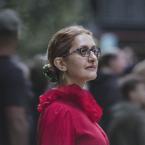
The library that made Yumna Kassab
Yumna Kassab – Western Sydney-based author – talks about the library that made her.
State Library of New South Wales
LTMM_Podcast_Yumna_Kassab.mp3
Welcome to the Library That Made Me Podcast.
I’m Phillipa McGuinness from the State Library of NSW.
On this podcast, we ask some of Australia’s most loved writers, historians, thinkers and performers to reflect on the libraries that have shaped them.
You’re about to hear from Yumna Kassab. Yumna Kassab is a writer based in Western Sydney and was the inaugural Parramatta Laureate in Literature. She is the author of The House of Youssef, Australiana, The Lovers, Politica, The Theory of Everything and most recently, Goodbye My Love.
I’m Yumna Kassab and this is the library that made me.
Where was I at the start of 2020?
I had just returned from a big trip to South America, and a few months earlier my first book — The House of Youssef — had been released. My intention was to work in Tamworth for the duration of the school year and with this mind, I thought I should finally check out Dixson Library at the University of New England.
My lifelong conundrum has been how to source the books I want to read without going broke in the process. It’s a dilemma that I’ve solved by immediately visiting the library in any place I’ve been, but access to a university library is a glorious thing, especially when it’s free to join for members of the local community.
I still remember that drive north from Tamworth to Armidale in the middle of February. It’s a peculiar mechanism of memory that most details fade and only some are committed to memory.
That was a particular drive: I was listening to Spanish songs and wondering how to explore the thread of Latin America that had opened up in my life. It also was the aftermath of the bushfires that had started burning in the September of the year before.
I had a mental goal as I arrived at the university. It was to fill out the application form to get my library card and then to find books relating to Latin America as per my reading list.
Labyrinths by Jorge Luis Borges was a long-ago discovery, and I’d read one book by Roberto Bolaño (Monsieur Pain) and one by Clarice Lispector (Água Viva). I hoped that this library trip would supplement the limited books already in my personal collection.
So I was issued a library card by security and I still remember the chat about the nutritional benefits of olive oil with a staff member at the front desk. Why is this the detail that remains and the rest have been wiped as if they never happened?
Memory tends to hinge on the act of routine that is repeated, but this would be my first and last trip to the library, and what was to come has painted this day even more vivid in my memory.
I don’t remember the layout of the library but I know I made a beeline for the shelf where I would find Borges. My reasoning was he would have other Latin American authors on either side. That is how I ended up with the interviews compiled by Magdalena García Pinto in Women Writers of Latin America and The Total Library by Borges. I also borrowed Poet in New York by Federico García Lorca in a bilingual Penguin edition with a photo of the poet himself on the front.
My intention was to borrow these books and to return them at the end of the loan period. That is how life operates in a normal world: you make a plan and then take actions to see through the plan, but I did not end up returning those books in March as I originally intended. Instead, I ended up living in them across all of 2020, to the point where I would dream about Poet in New York and I could quote from that book of interviews.
These were not my books and I felt entrusted with ensuring their safe return, but I was also grateful to have them during a time when bookstores were shut and libraries as well, as the world began to veer from a path of the predictable and normal. In the years ahead, there would be the pandemic with its lockdowns, there would be the death of two close friends, and the unbearable destruction of Gaza, and the realisation that I no longer knew what was meant by the word normal.
I play this trick at times, a writer’s sort of trick. I write a different return for those books. Rather than asking a friend heading to Armidale to return them for me at the end of 2020, I wind the clock back to March, and Yumna — with her borrowed books — is able to step into the library again as she intended. Had this happened, the world would have reset itself and I would have emerged once more to normality.
Of course this is ridiculous but it’s useful for carefully marking a line in my life.
There’s February 2020, the line, and then there’s this world that is exploding and crumbling at the same time. What existed before has been left behind and all I can hope is that at some point, a normal world will do its best to re-form and finally emerge.
Thank you for listening to the Library That Made Me. This podcast was produced on Gadigal land by the State Library of NSW.